
We are Baby Boomers, the generation conceived and born, as normal life picked up again, after the end of the Second World War.
Although we didn’t directly experience it, that period, 1939 -45, loomed large in our awareness as we were growing up. It was just called “the war”. Our world was “post war”. Our leaders, politicians, journalists, sports heroes, teachers, had been scarred and changed by their experiences of war time.
Adults of our parents’ generation, who had been children during the “Great Depression”, spent their early adulthood in the dominant shadow of world war.
Although our own family’s experience of life during the Second World War is not a story of front line service, guns, shells, bandages and gas masks figured large in their everyday life.
We always had an awareness that our parents had met at Maribyrnong Munitions Factory, where they both did their “war work”, but it is our father’s letters and our mother’s recorded memories that have brought those six years to life for us.
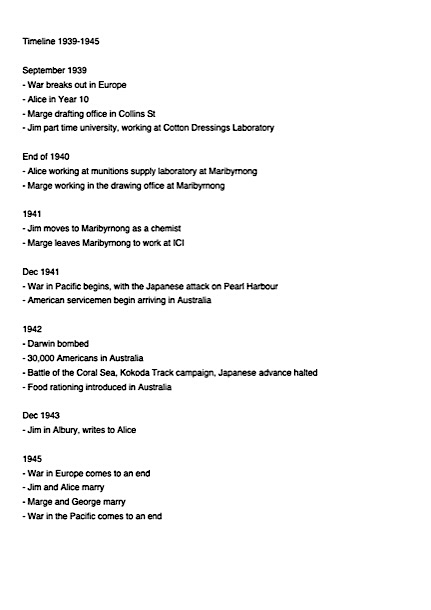
Timeline:
When war appeared on the horizon, in 1933, a major rearmament program for Australian Defence Forces began.
In 1933, our father was 12 years old, just settling into life as a boarder at Xavier College in Hawthorn, and our mother, 10, was still enjoying her Primary education in Croydon.
The Defence Explosives factory at Maribyrnong, where our parents eventually met, was a centre of the armaments modernisation drive: more factories, increased self sufficiency, new techniques.
From 1935, anticipating a large expansion in the facility’s workforce, new staff buildings were provided. We can imagine the meetings where the decision to build lots of facilities for women was made. They knew that it would be Victorian women, like our mother and aunt, who would provide a good deal of the labour for the massive increase in supplies, complexity and knowledge. War in Europe began four years later, and they were ready.
As war began, in 1939, Maribyrnong became a centre of research and development, as well as the main training facility for the manufacture of military explosives for Australia. They also manufactured and filled mines, depth charges and shells of all sorts. At this time, Alice was finishing her schooling, in Year 11, Marge was working in a drawing office in Collins St, and Jim was studying Science part time at uni.
By 1942 there were there were five hundred separate buildings on the site, and 8000 workers, 45% of them women.
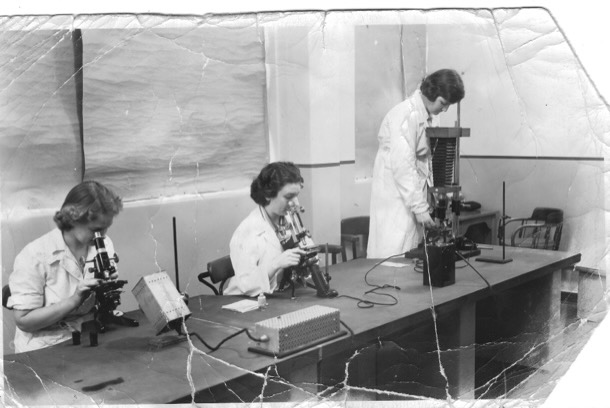
This included our mother and aunt. The first to work there, in the drawing office, was Marge. Our mother went to work at Maribyrnong straight from year 11 at MacRobinson Girls High School, at the end of 1940. On the strength of her Year 11 Chemistry, she worked with microscopes, at the Munitions Supply lab, counting the number of particles that made their way through the gas masks and investigating captured Japanese materials.
Listening room
Our Family in Wartime — audio recording 1
Transcript
I'll go on later about Maribyrnong, yes. I was eventually offered a job at the Maribyrnong drawing office and for two years sat with 19 other girls in five rows of four desks in a big high room overlooking the plains to the north. Our desks were spaced at such intervals that there was no possibility of us talking to each other. Alice, you went to Maribyrnong that year? Yes, I went in the end of 1940 to the munitions supply laboratories, and that was down near the explosives factory which was down at the bottom of Maribyrnong Road. There were sort of several complexes, weren't there? Down by the river, wasn't there? Yes, the munitions supply labs were near the explosives factory, which was the furthest most complex of the armaments and munitions works. In fact, the drawing office was not far from there. Eventually they ran the tram line, which would still be there, wouldn't it? The Maribyrnong tram that didn't go there when we started. We used to have to go by train to Footscray and bus from there.
My work was in the chemical defence section, which was attached to the factory that made the respirators, because of course there was the very lively expectation that there would be chemical warfare, gas warfare, as there had been in the First World War. We made respirators there in that factory, both civilian and for the forces. The laboratories used to test all the materials and quality control, I suppose. Most of the time I was there I worked with three others in the microscope section, and that's where we tested the penetration of gas that came through the filters in the respirators. And just kept a check on each batch, and I loved that work. We used to work pretty hard. Another thing we did there was to take in captured Japanese material, even pieces of their uniforms. We used to do the microscopic examination of the fibres that were used in their uniforms, and silly things like that. You would wonder how much of it was necessary and how much it was just to boost up the reputation of the chemists who were in charge. I remember the flame throwers, the thickened fuel that was used for flame throwers, and going down and watching the first test of the flame throwers, and being so appalled at that great long spurt of flame that was used in the tropics. And there was the various poisonous gases that had been used in the First World War were tested there, and I think even manufactured there in our laboratory. Yes, and of course the chemical warfare actually didn't happen in the Second World War. So I stayed there until I was married in 1945.
Alice, (foreground) at work at Maribyrnong:
Our father Jim began his war working as a chemist in the lab at Cotton Dressings, an industrial manufacturer based in Port Melbourne, specialising in the production of cotton wool and related surgical supplies. He had been turned down by the Air Force, because of his poor eyesight. In the middle of 1941 he transferred to Maribyrnong Laboratories. We are unsure of his exact role, but it was in the laboratory.
Jim, (left) and coworker at Maribyrnong:
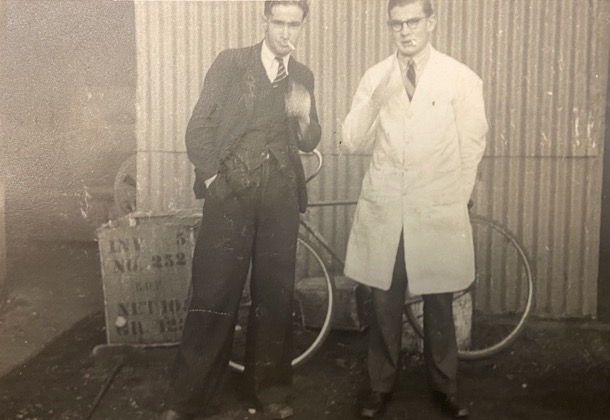
Of interest is the crate beside them . After researching, we it think may have been LOT 232 of a Mark 5 propellant or chemical component thereof, specifically prepared for naval use or long time storage in tropical environments. The NV probably stands for Non Volatile, hence the smoking right next to the crate.
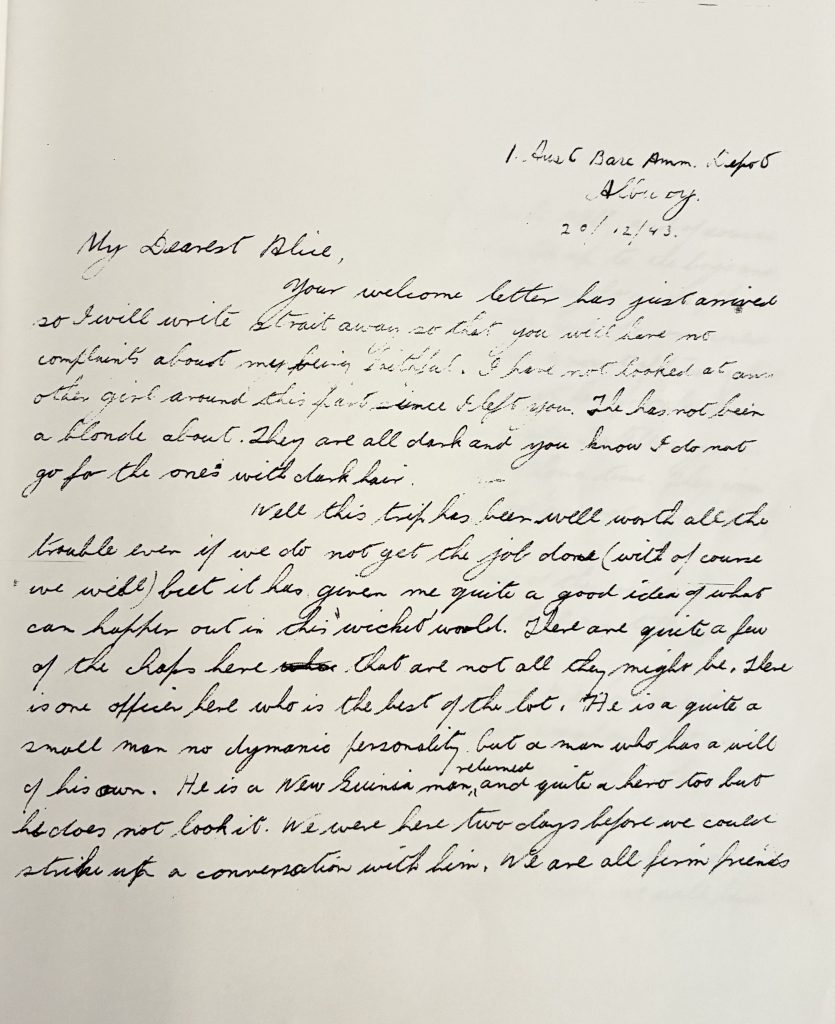
On the twentieth of December 1943 Jim wrote this letter to Alice from the ammunition depot in Albury:
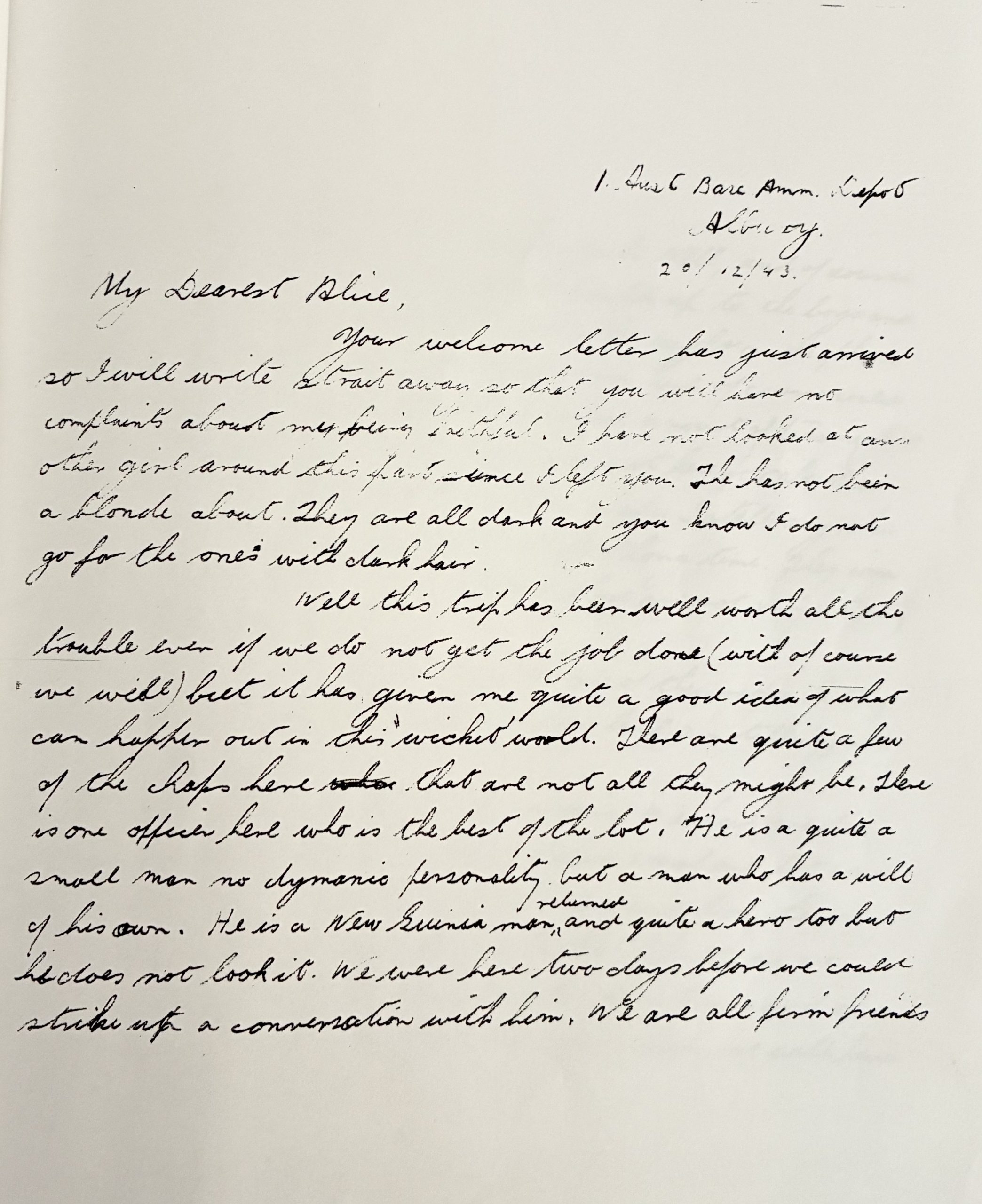
During World War 2 Albury was a military hub and quickly became a garrison town, due its natural advantages and existing rail and road network. Jim had apparently been sent there from Maribyrnong with a work colleague, Flynn, to design and make a number of tools for opening shells. This proved very difficult as metal and tools were in short supply. Jim wrote that they were both very pleased when they had opened “two hundred of one lot and three of another batch”. The tool then broke and they had to make yet another tool. Why was he in the Albury Army Ammunition Depot opening shells and what was inside those shells? We have no idea.We know that Jim did suffer blisters on his forearm after an accident in the laboratory involving mustard gas. So we wondered what was he actually doing in Albury and what type of shell were they trying to open? Why open them? What was inside them? We did some digging.At this stage of the war, late 1943, the Allied forces were concerned that the Japanese, who had used mustard gas in China, would also use it in the Pacific Theatre. We discovered that preparations for both offensive weapons and defensive equipment, were being made in Australia.
During World War II Australia held close to 1 million individual chemical munition weapons, at least 16 different types of mustard gas, some 35 types of chemical weapons at 14 major storage depots. ( mustard gas .org )
Storage of Chemical shells
1st Australian Army Base, Ammunition Depot was one of these storage depots and Maribyrnong, one of the research facilities. In 1943 one of the first large shipments of chemical warfare stocks and weapons arrived in Australia at Williamstown. Some of the men who unloaded the weapons and bulk supplies and then cleaned the hulls of the ships, suffered burns, blisters and other complaints. Many years later they did receive compensation because they were civilians. The stocks and weapons were then sent to Albury, where they were stored in open sided sheds 400 metres apart and set in a line against a hill. Ist Army Base Albury held thousands of shells, among them, 20,268 25 pounder mustard, 272 tons of 3 inch phosgene, 3,500 chemical mines etc. CW (chemical warfare) weapons and supplies were also stored in Sydney in disused railway tunnels and in depots in Queensland.
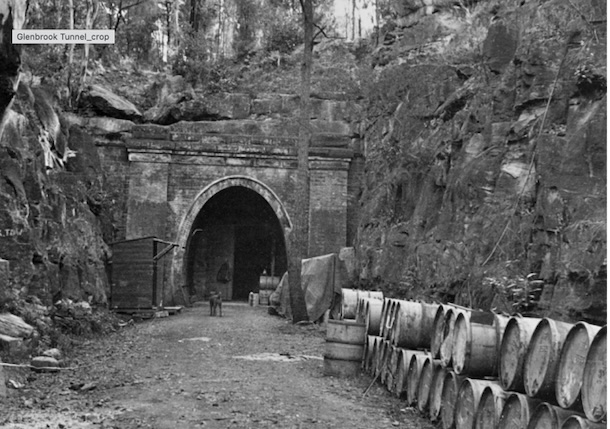
Photo: National archives of Australia
Australia was engaged in research into, and planning for, offensive and defensive CW usage. Queensland was chosen as the site for the highly secretive trials, as the climate replicated the conditions in which the CW weapons were likely to be used. The trials and the results remained classified for decades.
RAAF men, sitting on shells:
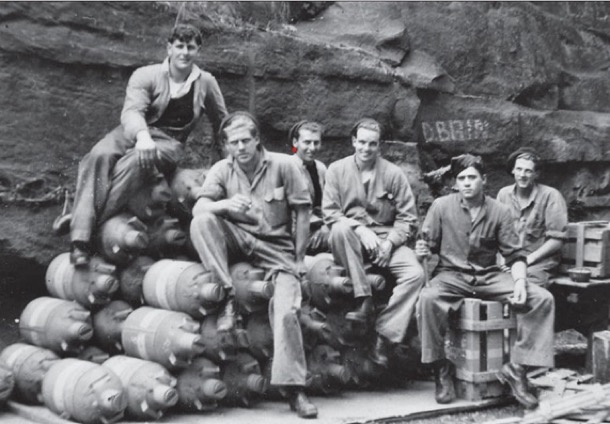
Photo: National archives of Australia
The trials were held on a remote island off the Queensland coast. All personnel were volunteers and included some service women. Wearing full protective gear, they were landed on Brooke Island and shells loaded with various chemical agents were dropped by the Airforce. The volunteers were to sample and assess the gas concentration and effectiveness. This included an assessment of the effectiveness of their protective gear. People experienced various symptoms, including fever, headaches, backaches and, in some cases, severe mustard gas poisoning. Many participants reported not being fully informed about the risks or nature of the experiments. Many received compensation years later.
Defensive equipment:
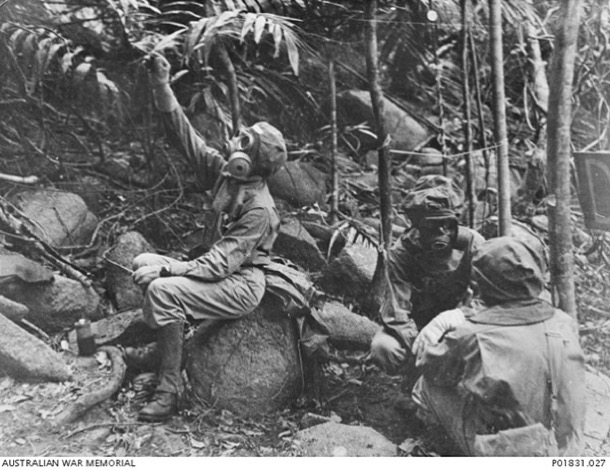
Photo: National archives of Australia
Our parents were both required to sign the Official Secrets Act, but as far as we can ascertain without any specific information, they were both involved in assessment of defensive equipment and maybe aspects of the chemical warfare shells.Back in Albury, Jim, pleased that he had accomplished what he had been sent to Albury to achieve ,was free to return to Melbourne. He and his friend Flynn left Albury on the train at 6.50 AM and arrived at Mansfield at 3.30 PM, after a very slow journey. Fuelled up with a big steak, they then started the experience about which Jim wrote in his letter to Alice.
Albury Station:
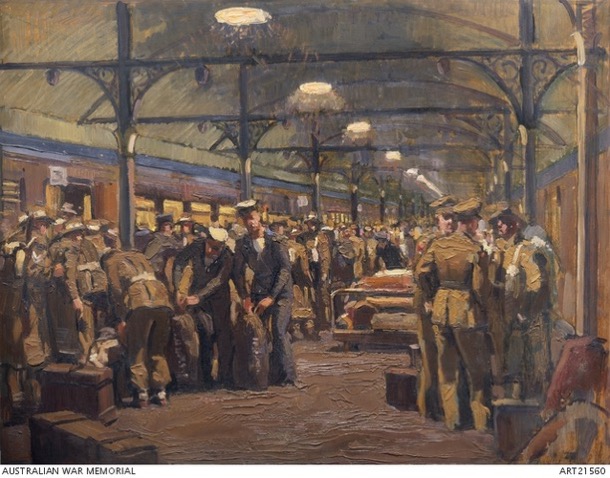
It was quite a journey, as they were intending to ride push bikes, laden with camping gear and other supplies, to Jamieson. According to local reports at the time, the Jamieson Track, a distance of thirty miles, was not well maintained and was a very rough road. Flynn was having trouble with his feet and found his bike difficult and so they swapped bikes. They reached The Gap, a very steep hill “as steep as any I have ever seen”. The letter continues, “Flynn’s bike had no brakes so I could not stop. That suited me fine until the valve blew out of the front tyre. That bike took control from then on and I did everything I knew to stop on and keep the bike up. I stopped on alright and eventually the bike stopped. The front tyre had 5 holes in it and we only had a pump.No puncture outfit or spanners to do anything to it. We were 10 to 12 miles from Jamieson. Well, I set sail on the bike thinking it was only 6 miles. By the way it was raining also and beginning to get dark. I reached Jamieson in an hour by riding like hell while it was still daylight. I had to do the last 2 miles in the dark without a light because the road had shaken my light to bits.”The chapter of disasters continued as the publican at Jamieson would not give them a bed or a meal. Therefore, having picked up a puncture kit, Jim: “set sail again. It was a long way back and was I tired! Well, when I found Flynn, he had walked 3 to 4 miles with the bike and had got an outfit to fix it with. My leather coat was wet through. We reached Jamieson about 10 o’clock and no place to sleep. There was only one light in Jamieson so we went there. The old chap put us up in a shed at the back the house and gave us some supper. I slept like a top that night.“
The adventure appears to have gone more smoothly from then on as Jim and Flynn found a place to camp, did a little shooting and fishing and eventually rode, via Molesworth, to his Uncle’s property Alencon, located between Molesworth and Yea. They stayed there for several days, enjoying Jim’s relative’s hospitality and then returned to Melbourne presumably on the train from Yea.
Young Jim with his gun:
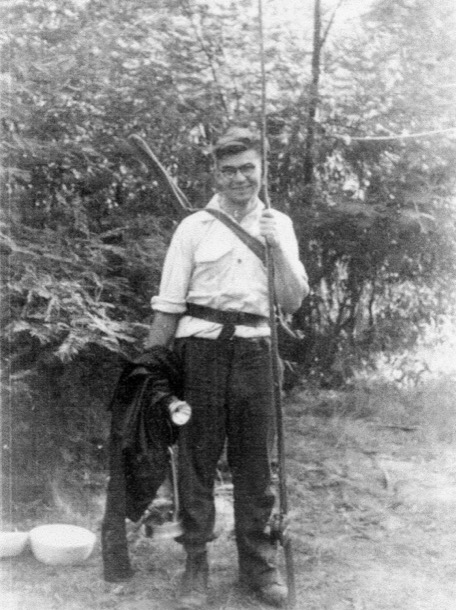
We are none the wiser about the outcome of this adventure and the nature of the task Jim and Flynn were sent to complete, as we have no more letters. Maybe he had already said too much in these letters to Alice as it was wartime and there were many restrictions in place on the freedoms we take for granted today.
Marge and Alice discuss their arduous journey to Maribyrnong from Surrey Hills where they lived at the time.
Listening room
Our Family in Wartime — audio recording
Transcript
It would be interesting to talk about how we got there, and how long it took, and how much it cost us.
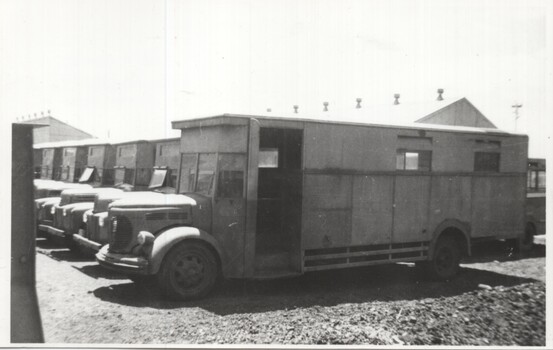
We were living, of course, in Surrey Hills. And I remember I'd travelled two hours there and two hours back. And, first of all, we went by train to Footscray and then caught a bus from Footscray to Maribyrnong. And the buses were just simply like army trucks— Trucks colourfully coloured. Yes, just with the wooden seat along each side. Very uncomfortable.
And then, as I said, later on they did build the tram route to Maribyrnong. A lot of people went from the city by tram. And some went, after a while, to Ascot Vale and then walked to that tram in Maribyrnong Road. And I went, for a while, with Jim in Barkarba, of course. And that was very elite. Because there was petrol rationing and he only had the petrol for that. Because his father was a doctor and had extra supplies.
But the fares— Yes. Well, I started on twenty eight and six, but two pounds eight and six. Yes, Two pounds eight and six. One pound eight and six, but twenty eight and six, yes. And the fare cost ten shillings and sixpence. So that's about a third. A third of your wage in fares. That's right. Yes.
They speak of traveling on “buses that were like army trucks”.
These were called “austerity buses”. Timber and canvas bodies were built onto second hand truck chassis. The factory that made them was in Preston. Here is a photo of the “austerity buses” at the factory:
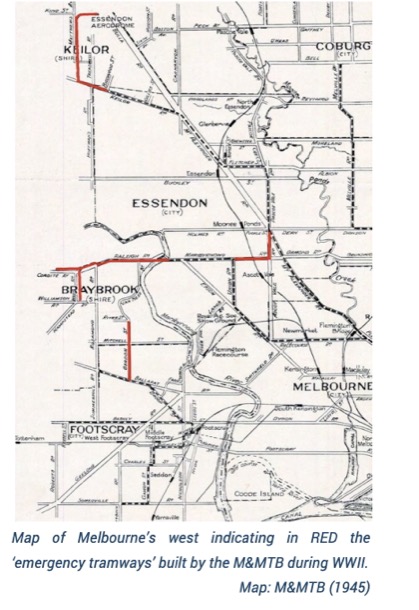
Later a tramline was built specifically for the Maribyrnong workers. In 1941 the Commonwealth (under its emergency powers) ordered the State’s Metropolitan Tramways Board to create new tramlines, one of which was put in place from Moonee Ponds to the Ordnance Factory to do away with the austerity bus service.
This article from The Argus from October 1940 discusses this decision:
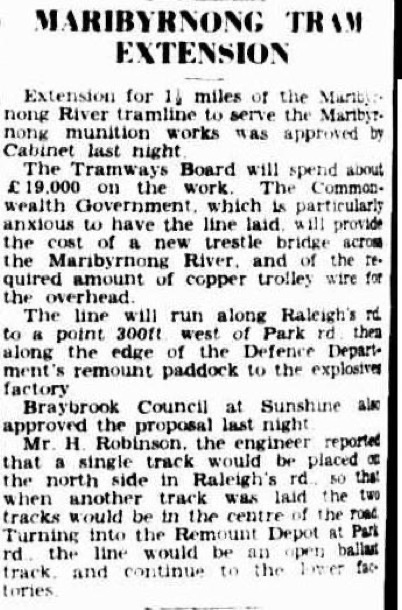
Eventually, the lines were joined together to create one of the strangest tram routes in Melbourne – the Number 82 from Moonee Ponds to Footscray via the byways around the Maribyrnong site.
After Japan came into the war in late 1941, the threat of attack on the Australian mainland became much more real.
At Maribyrnong, safety was a massive priority. The buildings were well spaced on the site, with earth and concrete blast walls to contain accidental explosions.
Materials had to be transported around the site, in such as way that friction and sparks were avoided. “Clearways” were developed: elevated smooth roads, on which vehicles with rubber tyres drove slowly and carefully.
Footpaths, too, were concrete, containing a lot of gypsum, to minimise sparks.
There were air raid precautions, with bunkers, individual ones, just a pipe vertically buried in the soil, and slit trenches for groups. They must have been well aware that a munitions site was a prime target for enemy attacks.
Listening room
Our Family in Wartime — audio recording
Transcript
Yes, and of course the air raid. The air raid drill we used to have at Marylebone. They built slip trenches and we used to have them drilled, and go down to those. And even in the suburbs, Mummy and Daddy belonged to the ARP. Yes, Air Raid Precaution Officers. And they used to practice at putting out incendiary bombs and things like that. And Mummy wore dungarees. I remember her coming home looking very silly because she was in pants. Yes, but she looked elegant. And Daddy actually built an air raid shelter in their back garden. So you know it was a real threat. And in fact one night they were called out in the middle of the night for their air raid precaution duties, because a submarine had been sighted down near Wilson's Promenade.
And of course, Marge, there was the raids on Darwin and Brewer. And we heard about one or two raids on Darwin. And it wasn't until well after the end of the war that it was publicised how severe and how many raids there were on Darwin. So I believe. And there were even a couple of shells on Sydney. Oh, that's right. The midget submarines came in there, didn't they? That's right. And actually fired the shells. And property values on those wonderful harbour sites of the wealthy. Everybody got out. Everybody got out, and the property values went down.
Like many Australians, our grandfather built a shelter in their Surrey Hills backyard.
Alice and Marge mentioned almost in passing that their parents were in the ARP, and went out after work, Alfreda looking very “elegant” in her “dungarees”.
A Government campaign recruited men who were too old to serve, and also women, to be volunteer air raid wardens (ARP) for Melbourne’s municipalities.
This charming old photo depicts Sydney shop girls preparing for ARP duty:
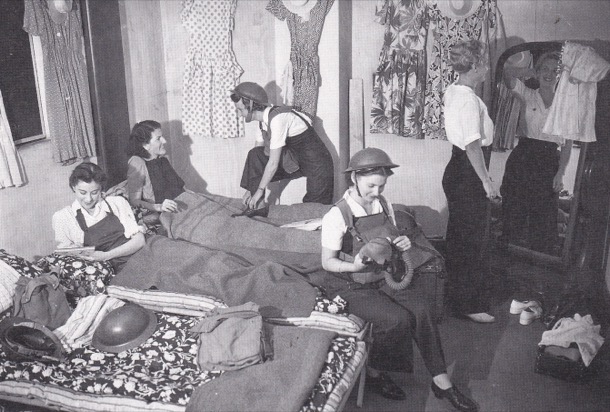
Photo from the book series “Australians at War”
The Australian system was modelled closely on the English one. ARP wardens carried gas masks, helmets, torches and rattles or whistles. Their main duty was to patrol the black out, that, in Melbourne was really only a “brown out”.
Listening room
Our Family in Wartime — audio recording
Transcript
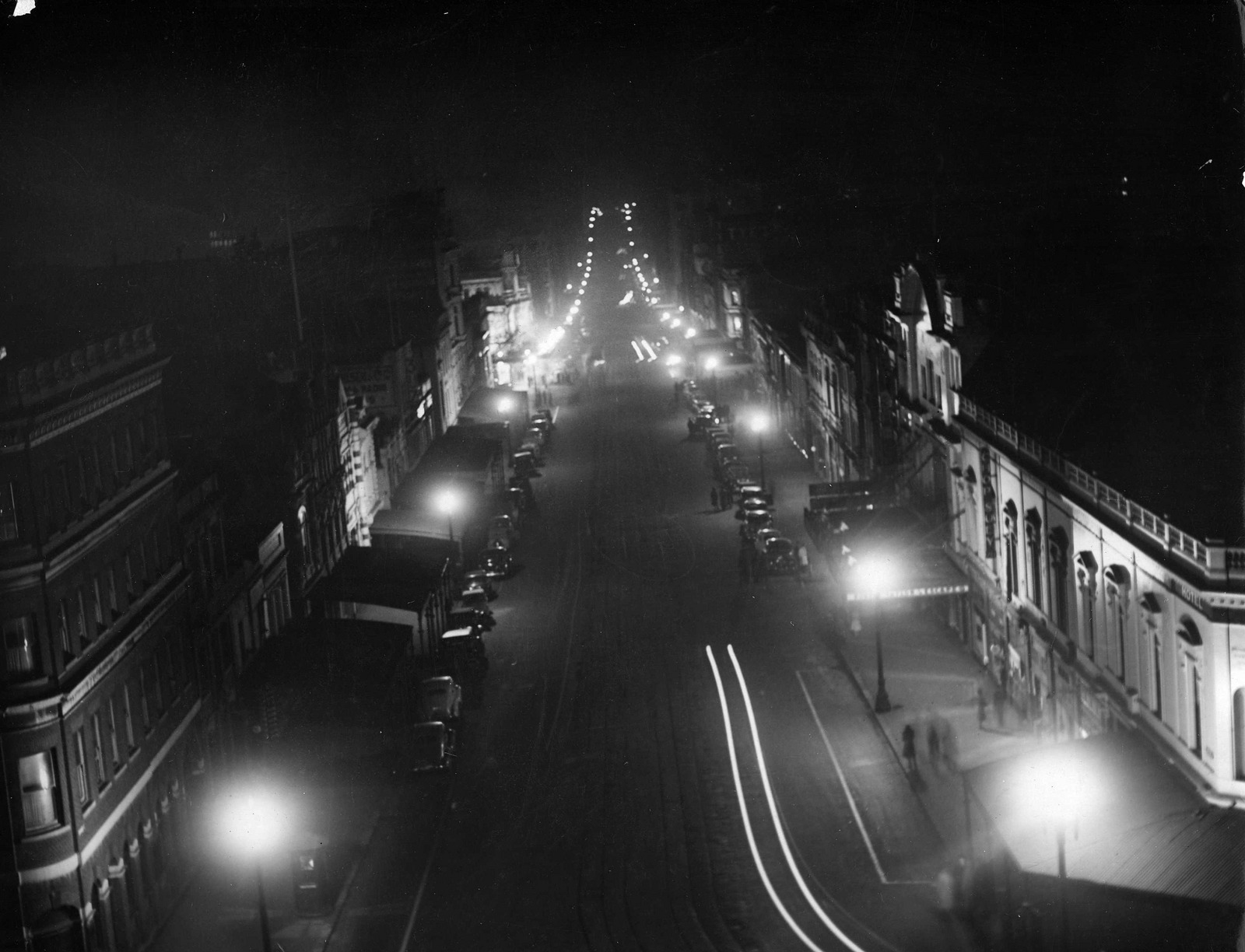
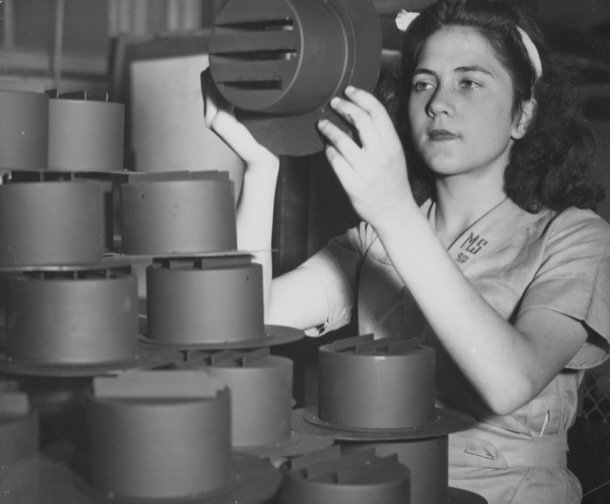
But Alice, the blackout— oh yes— you know how we used to. Well, after Japan came into the war, wasn't it after the war was declared? Yes, things got a bit serious then, didn't they. We had the blackout; every house had to have the windows, just as it was in Europe, had to have the windows covered before the lights were turned on at night with shutters. We didn't ever turn a light on without being sure the shutters were on. And the street lights, and the lights in the trains, and the car lights, all had to have the black over their hood, over them. No more than a hood, the whole of the lens was covered with black paper and just a hole in the middle, a small hole in the middle. I'd forgotten that.
And in the trains, and we sometimes worked at night, didn't we, until nine o clock, and the trains were full, but they were very almost dark. Very, very little light came through in the trains anyway. And so that, of course, when the end of the war came and the lights went on— Oh, I can remember that was a wonderful time
Blacked out Melbourne street:
Blackout masks for cars:
Photos: State Library Victoria.
Our Grandfather, Alf was 49 years old, when war broke out.
Listening room
Our Family in Wartime — audio recording 1
Transcript
Sometime during the war our father left his job in Croydon and joined a government department called the Contracts Board in the city. At that time the government was contracting with manufacturing firms for war materials and equipment. I sat in the Melbourne office and applauded his not having enough work to do. He was requested to have an open letter on his desk in front of him so that he would look as though he were working. Same old public service problem. After a while he was offered a job with a firm who had a contract with the government for waste rag for cleaning purposes. I think he might have been seconded to that job. Because there wasn't the freedom to choose your jobs by this time. Don't you remember? At the beginning of the war you could. For instance you went out to Maribyrnong. But after a while people weren't given that freedom. And you couldn't leave jobs without permission. Take on other jobs without permission. So I think he was probably sent there. Yes I haven't been there since. Anyway the job was for managing the firm which sorted out waste rag for cleaning purposes. For machinery guns and such things. At that time the Red Cross was to take over the firm. The original owner was to stay on in an overseas capacity. And Alf was to be the manager. Something like that.
It was in Gipps Street Collingwood wasn't it? And it had been one of the big waste product firms in Melbourne. And do you remember Alice that our father used to talk about the women he was in charge of? Yes he hired and fired these lesser women. The sorters. That's right. And they were the Collingwood factory women. And Aunty Pearl at one time worked for him. Yes in the office. Did you go to work? Yes well I was to go there after I was married because I couldn't go back to my job at the munitions supply lab. Because my husband and wife weren't allowed to work together. So I was to go and help him in his office there. But it didn't eventuate because the war finished and the job went.
Using the British system of rationing as a model, Australia introduced food rationing in June 1942. Customers surrendered coupons to retailers when they took the goods. The retailers passed coupons back to wholesalers, who, in turn passed them back to producers and eventually back to the Rationing Commission.
Listening room
Our Family in Wartime — audio recording 2
Transcript
Remember the orderly queuing that there was at the little kiosks throughout the city. Where it would become known that chocolates had come in and cigarettes, and you'd see a queue. It's a bit like Moscow now, where they're short of food and people see a queue, and they join in to get the flour.
Sometimes we didn't even know what the queue was for, and we'd come out with a quarter pound block of Cadbury's chocolate as a prize. Do you remember those plain wrappers? No silver paper. So that was orderly queuing.
You should have seen us in the train. Do you remember how we scrimped and saved our clothes? Clothes rationing. Clothes rationing. And made every piece of cloth. Yes. And I remember I had a dressing gown that Aunty Bird made out of furniture fabric. Furniture fabric. It was beautiful. Heavy velvet couch cover. It was beautiful.
And when I was married, a friend had a supply of coupons for maternity clothes, and I evidently hadn't used them all. And I got some of those to buy. But I had to buy lingerie material. It had to be something that would have been bought for a woman's lying. Yes. And we had lots of tickets. That's right, and they'd be cut up with scissors.
And even a pair of stockings. We got 56 a year, didn't we? 56, yes. And I think a pair of stockings was four. So we didn't have many clothes. We only had very little.
And the shops were almost empty. They had a lot of things I remember made from felt. They had, instead of jewellery and beads and that sort of thing, they'd have little strings of felt flowers that you could put around your neck.
And food. Yes, yes. Tea, sugar, butter and meat. And it kept on for quite a long time after the war. Well, when Susan was born, I had coupons for her.
And as for setting up house, see, we were married in 1945, and I think we got a supply of coupons specially. A few, I think. You could buy, for instance, I think two towels and perhaps four sheets. No blankets. You didn't get coupons for blankets. No, just tablecloths and things like that. Yes, just minimum to set up.
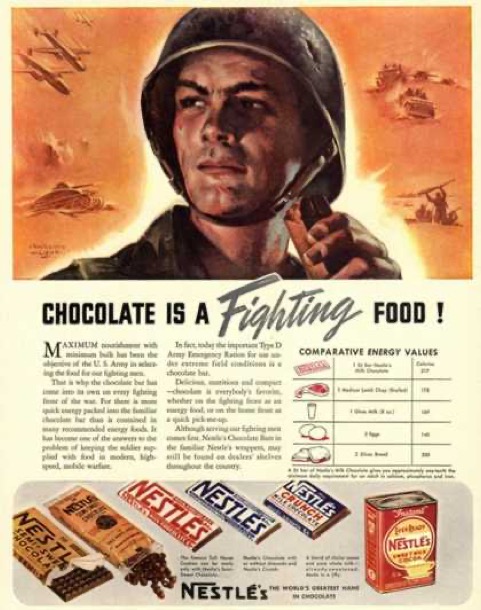
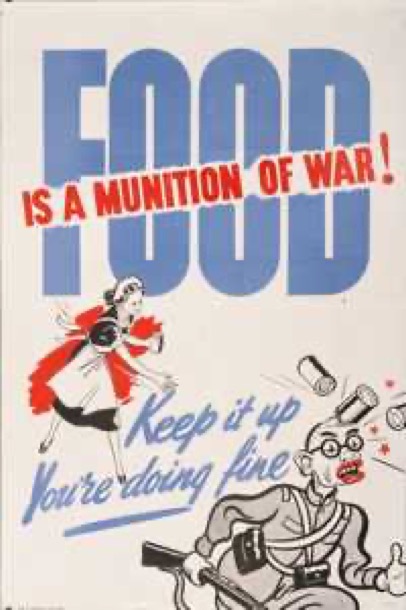
Photos: Australian War Memorial
During the war, Melbourne was a major base for American servicemen, with more than 30,000 stationed here in 1942. Many were housed at Camp Pell in Royal Park, as well as in requisitioned guest houses and other smaller camps in Melbourne. For instance 200,000 US personal: Army, Airforce and Marine, passed through the MCG ,which was another transit camp.
The Americans had quite an impact in wartime Melbourne. Their smart uniforms were well tailored and they were dressed ‘superbly’, compared to the ‘shabby ‘ uniforms of the Australian personnel. They made quite a spectacle as they marched through Melbourne. The phrase ‘overpaid, over sexed and over here’ was a local sentiment seen in newspaper articles and no doubt in conversation.
American servicemen on the streets of Melbourne:
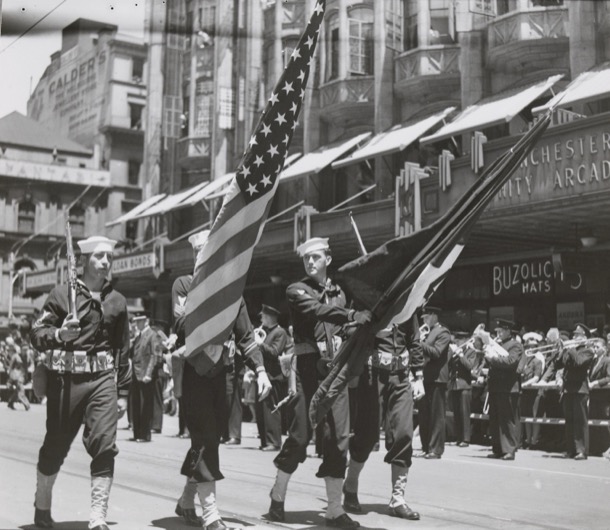
Photo: State Library Victoria.
The influx of Americans brought immediate cultural changes, as they introduced Melburnians to hamburgers, Coca-Cola, and coffee. They also came with nylon stockings for the girls, and Mars Bars for all and sundry. The American privates often earned more than Australian sergeants and their popularity with local women led to significant friction. The antipathy to the Americans was also fed by the feeling that they took all the credit for turning back the enemy. Marge and Alice comment on the noticeable presence of American Military Police. In fact they say that the streets were ‘swarming’
with Military Police. Street brawls did break out, and in 1943 one such brawl involved 2000 to 3500 soldiers and civilians.
Social life during the war consisted of going to the movies and newsreel cinemas. Jim and Alice did that a lot. There were also local dances at Surrey Hills. Marge loved these, and tripped off in a long evening gown and velvet evening coat, no doubt made by Auntie Bert. She danced with the local men and boys in their bow ties and suits.
Marge, like many Melbourne girls, found the presence of the Americans exciting, and she particularly enjoyed going out dancing with them.
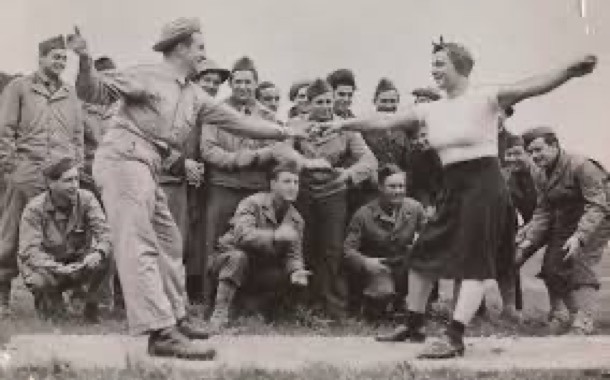
Photo: State Library Victoria.
It may have been at one such venue that she met Captain Bill Jones, an American Marine. He was stationed in Ballarat. As there was an understanding between them that they would marry after the war, Marge was allowed to visit him in Ballarat. Marge and the family expected that she would become one of the 15,000 war brides who moved to the USA after the war. This was not to be, as George Rostos, a Hungarian refugee, began courting Marge, once he knew that her Bill Jones was not an Australian serviceman, but an American. George won out, and they were married at the end of the war.
News of the war was from the newspapers and radio but also from newsreel cinemas.
Marge ‘haunted’ these in an attempt to get news, while Bill was away. She comments that the war reporting on films was not only heavily censored, but that the fighting was always filmed at a distance and never at close quarters.
During the last year of the war both Marge and Alice married. The war ended in Europe in May 1945 and in the Pacific Theatre in September. Marge married George Rostos a Jewish Hungarian refugee and Alice married Jim, a Roman Catholic. Both these romances were a product of the war. George escaped the rise of the Nazis in Europe and came to Australia, and Alice and Jim met at the defence facility at Maribyrnong. According to Marge, their parents coped well with their unusual choices, as they all negotiated the mostly welcome changes brought by the end of the war.